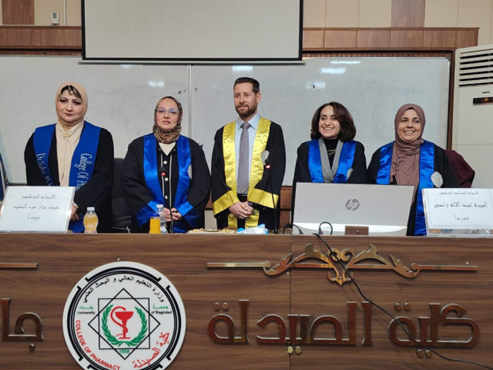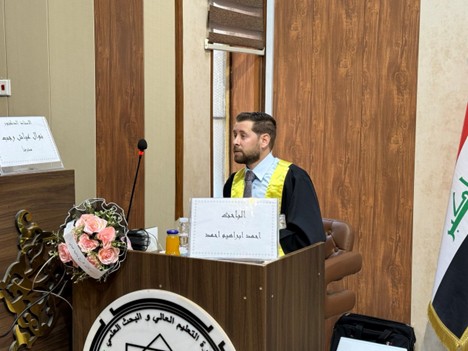
The College of Pharmacy discussed the MSc thesis entitled “Preparation and Characterization of Mirtazapine-Loaded Pronanomicelles as Oral Dosage Form” by the student Ahmed Ibrahim Ahmed and the supervisor, Professor Dr. Nawal Ayash Rajab, at the Pharmaceutics Department.
The study aimed to increase the solubility of mirtazapine (MTZ) in order to enhance the drug bioavailability, and ultimately formulate it as a sublingual tablet.
The study included preparation of pronanomicelle formulations using Soluplus®, Poloxamer 188, and D-ɑ-tocopheryl polyethylene glycol succinate (TPGS), after which MTZ was encapsulated into the polymeric micelles using different ratios and combinations of Tween 20, Tween 80, TPGS, poloxamer 188, and Solutol HS via the thin hydration (solvent evaporation method to facilitate micelle production and ensure effective encapsulation of MTZ. Subsequently, the optimized nanomicelle formulation was incorporated into sublingual tablets using the direct compression method.
The results showed that the optimal formulation consisted of a 1:10 MTZ:Soluplus ratio, exhibiting a particle size of 57 nm, a polydispersity index (PDI) of 0.035, entrapment efficiency of 90%, drug loading of 8.23%, Zeta potential of -36.56 mV, and in vitro drug release was 95% in 50 minutes. Furthermore, morphological analysis revealed the presence of spherical micelles, and Fourier-transform infrared spectroscopy (FTIR) indicated no chemical interactions, supporting micellar structural integrity. Moreover, differential scanning calorimetry demonstrated that MTZ was present in an amorphous state. Additionally, the optimized sublingual tablet showed a disintegration time of 50 seconds and achieved 100% drug release within 4 minutes.
The study recommended conducting further in vivo studies to confirm the efficacy of the developed formulation compared to conventional dosage forms, as well as applying this nano-system to enhance the properties of other poorly soluble drugs.