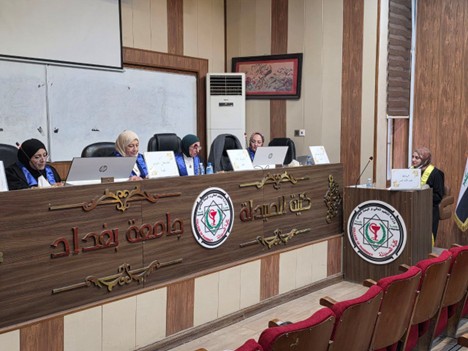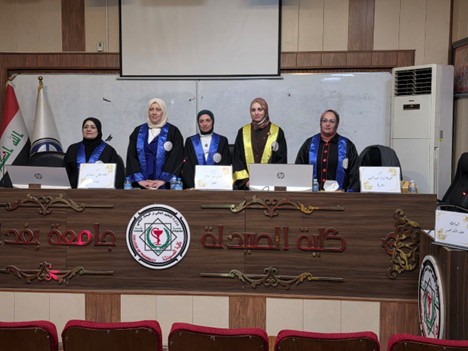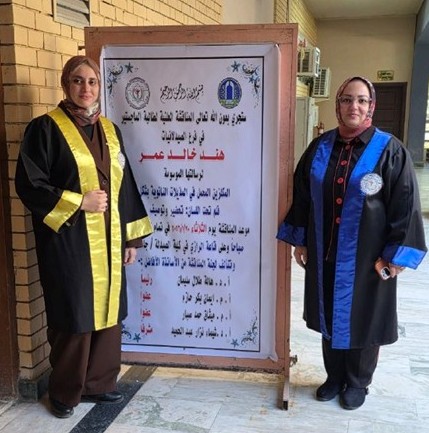
The College of Pharmacy discussed the MSc thesis entitled “Meclizine Loaded Nanomicelles as Sublingual Film: Preparation and Characterization” by the student Hend Khalid Omar and the supervisor, Professor Dr. Shaimaa Nazar Abd Alhammid, at the Pharmaceutics Department.
The study aimed to develop, characterize, and assess MLZ-loaded nanomicelles in various combinations of amphiphilic polymers and incorporate the optimized nanomicelle preparation into fast dissolving sublingual films to achieve greater therapeutic efficacy and to enhance the solubility, release profile, and bioavailability potential of MLZ by using a new nanocarrier-based system of oral delivery in the mouth.
The study included the direct dissolution method for the preparation of MLZ-loaded nanomicelles. Soluplus was combined with either Tween 80 or D-α-tocopheryl polyethylene glycol 1000 succinate (TPGS) at different weight ratios to formulate the nanomicelles. The prepared formulations were evaluated for particle size, polydispersity index (PDI), zeta potential, drug content, drug loading, entrapment efficiency, and in vitro drug release. Based on these evaluations, the optimal formulation was selected. Further physicochemical characterization of the optimized nanomicelles was conducted using Fourier-transform infrared spectroscopy (FTIR), X-ray diffraction (XRD), field emission scanning electron microscopy (FESEM), and cloud point determination. The optimized nanomicellar formulation was subsequently incorporated into fast-dissolving sublingual films using hydroxypropyl methylcellulose (HPMC E5) as the film-forming polymer, glycerol as a plasticizer, and crospovidone as a superdisintegrant. The prepared films were evaluated for thickness, folding endurance, disintegration time, surface pH, swelling index, uniformity of drug content, and in vitro drug release profile.
The results showed that the optimized nanomicellar formulation (N23), composed of 25 mg MLZ, 50 mg Soluplus, and 25 mg Tween 80, exhibited favorable physicochemical characteristics. These included a particle size of 58.74 ± 1.33 nm, a low polydispersity index (PDI) of 0.125 ± 0.03, high entrapment efficiency (98.52% ± 1.24), a zeta potential of +3.90 ± 0.18, a solubility factor of 7.56 ± 0.12, a drug loading of 24.86 ± 0.11%, and a drug content of 98.59% ± 0.28%. In addition, formulation N23 showed a significantly enhanced in vitro release of MLZ compared to other formulations. Fourier-transform infrared spectroscopy (FTIR) and X-ray diffraction (XRD) analyses confirmed the molecular dispersion of MLZ and the amorphous nature of the nanomicellar system. The prepared sublingual films exhibited satisfactory physical and mechanical properties, rapid disintegration, and complete drug release within less than one minute. The optimized film formulation (F10) demonstrated a thickness of 0.15 ± 0.04 mm, a folding endurance of 254.0 ± 2.0, a disintegration time of 38.0 ± 0.2 sec, a swelling index of 29.93% ± 3.6, a surface pH of 6.5, and a tensile strength of 1.56 ± 0.14. Furthermore, formulation F10 achieved an in vitro drug release of 94% within 90 min and an ex vivo release of 93% within 60 min, indicating a marked enhancement in the solubility and dissolution behavior of MLZ.
The study recommends conducting further in vivo and pharmacokinetic investigations to confirm the enhancement in bioavailability suggested by the in vitro and ex vivo findings. In addition, studies addressing the stability, expiration date, and shelf life of the developed formulation are necessary. Future work should also focus on evaluating the reproducibility, economic feasibility, and regulatory compatibility. Moreover, scale-up studies assessing manufacturing routes consistent with industrial production standards are strongly recommended.