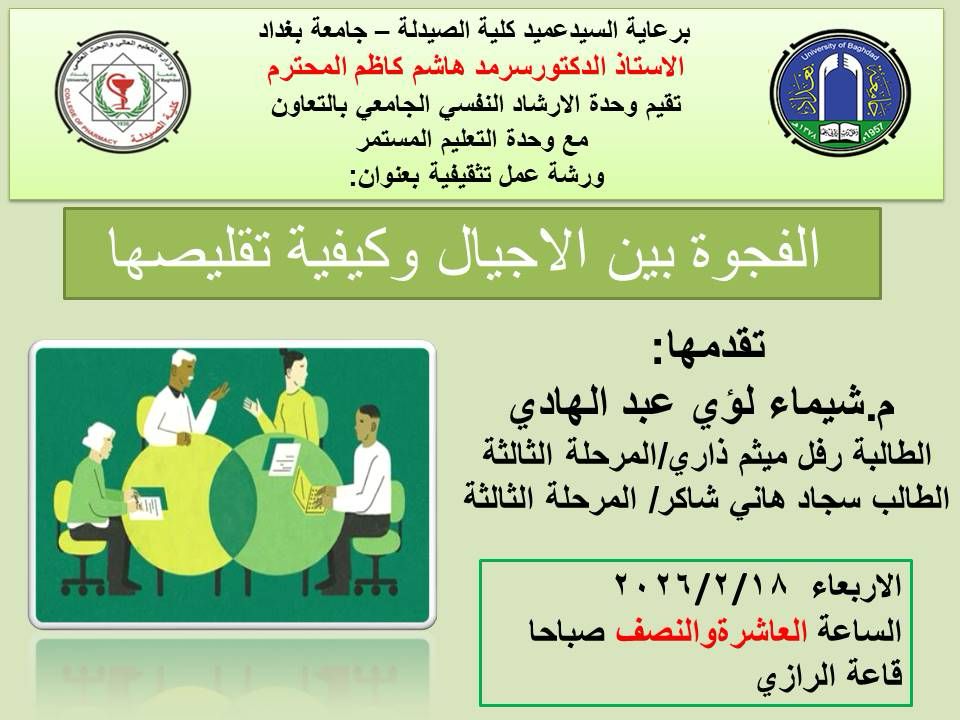
Under the supervision of the Dean of the College of Pharmacy, Professor Dr. Sarmad H. Kathem Al-Khateeb, the University Psychological Counseling Unit in cooperation with the Continuing Education Unit at the College of Pharmacy/ University of Baghdad, held an in-person workshop entitled “The Generation Gap and How to Reduce It,” delivered by Lecturer Dr. Shayma Luay Abdulhadi, a faculty member at the Pharmaceutical Chemistry Department, with participation from third-year students Sajjad Hani Shaker and Rafal Maitham Dhari.
The workshop aimed to establish channels for understanding and communication between generations to reduce the gap resulting from differences in cultural, intellectual, social, and customary aspects due to rapid development, highlighting that variations in values, principles, ambitions, desires, and perspectives contribute to widening this gap.
The workshop included several key topics, including the risks of the generational gap and its impact on weakening the bond between parents and children due to differences in values, experiences, cultural and technological contexts, lack of parental supervision, and youth rebellion. A survey of 92 undergraduate students confirmed the existence of this gap, with 44% reporting that it causes family problems, 55% willing to change some of their views if convinced by the other generation, and 58% identifying dialogue sessions as the most effective way to bridge perspectives. Discussions between students and faculty concluded that open dialogue and flexibility in accepting changes are the best means to reduce differences and enhance intergenerational awareness.
The workshop concluded that building the younger generation begins with the family, especially the mother, by promoting ethical values and raising awareness in educational institutions from kindergarten onward using technology. It emphasized that the older generation’s experiences constitute a valuable resource, while the younger generation brings innovative ideas, highlighting the importance of integrating efforts to achieve balance and address current challenges.


