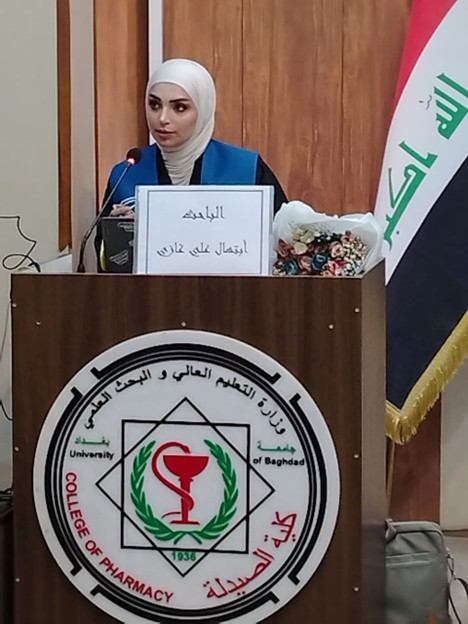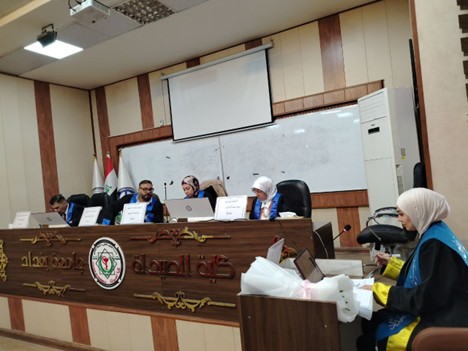
The College of Pharmacy discussed the MSc thesis entitled “Phytochemical Investigation of Codiaeum variegatum L. (Euphorbiaceae) Cultivated in Iraq and Evaluation of Cytotoxic Activity” by the student Ebtihal Ali Ghazi and the supervisor, Assistant Professor Doha Abdul Sahib Abdul Hussein Al-Shammaa, at the Pharmacognosy and Medicinal Plants Department.
The study aimed to identify the active constituents of Codiaeum variegatum cultivated in Iraq and to evaluate its potential as a natural source of bioactive compounds.
The study included sequential extraction of Codiaeum variegatum using a Soxhlet apparatus. The fractions were analyzed by thin-layer chromatography and gas chromatography-mass spectrometry; high-performance liquid chromatography was used for qualitative and quantitative analysis and Fourier-transform infrared spectroscopy for n-hexane and methanol fractions. Preparative layer chromatography was used for the isolation of the alkaloid compound from the dichloromethane fraction. The isolated alkaloid was identified by melting point, Fourier-transform infrared spectroscopy, Liquid Chromatography-Mass Spectrometry and proton nuclear magnetic resonance.
The study concluded the presence of β-sitosterol and lupeol in the n-hexane fraction, caffeic acid, rutin, vitexin, and chlorogenic acid in the methanol fraction, which was isolated by several runs of high-performance liquid chromatography of the plant. An alkaloid isolated from the dichloromethane fraction. The result showed an effect on cell morphology, like cell shrinkage and the formation of apoptotic bodies, which could indicate cell death. This combined with a decrease in cell density, suggests a cytotoxic effect.
The study recommended that additional advanced pharmacological and pharmacodynamic studies on Codiaeum variegatum should be conducted to further evaluate its therapeutic efficacy and explore its potential for future use in developing natural pharmaceutical preparations.