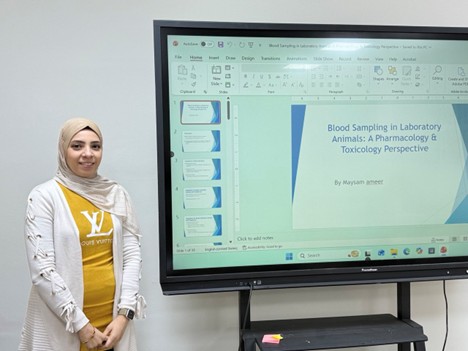
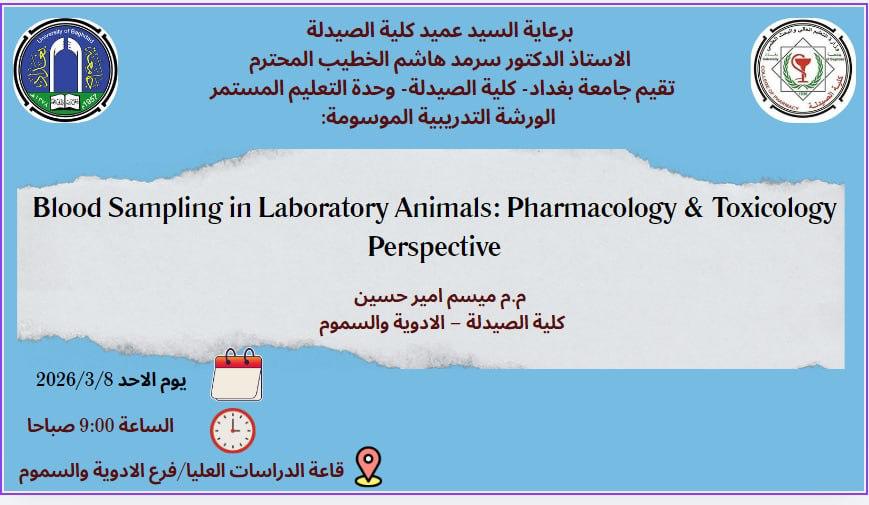
Under the supervision of the Dean of the College of Pharmacy, Professor Dr. Sarmed H. Kathem Alkhateeb, the Continuing Education Unit at the University of Baghdad/College of Pharmacy held an in-person workshop entitled “Blood Sampling in Laboratory Animals: A Pharmacology & Toxicology Perspective”, delivered by assistant lecturer Maysam Ameer Hussein, a faculty member at the Pharmacology and Toxicology Department.
The workshop aimed to introduce the importance of blood sampling in laboratory animals and the scientific procedures required to obtain accurate samples while ensuring animal welfare.
The workshop included several scientific topics, including the importance of blood sampling in pharmacokinetic and toxicokinetic studies, as well as in the analysis of biomarkers. It also addressed the total blood volume in laboratory mice and rats and the safe limits for blood collection in both non-terminal and terminal sampling procedures. In addition, the workshop discussed the ethical principles governing the use of laboratory animals and adherence to the 3Rs principle (Replacement, Reduction, and Refinement). Furthermore, the session explained sample processing methods using anticoagulants such as EDTA for hematological tests, heparin for plasma analysis, and citrate for coagulation studies, in addition to outlining appropriate storage conditions for samples (short-term storage at −20°C and long-term storage at −80°C). The workshop also reviewed factors influencing the sampling process, including the species and strain of the animal, age, health status, and the site of blood collection. Various blood sampling techniques were also discussed. In mice, these included the retro-orbital plexus, submandibular vein, saphenous vein, and cardiac puncture. In rats, the methods included the jugular vein, retro-orbital plexus, saphenous vein, and cardiac puncture.
The workshop concluded that blood sampling from laboratory animals represents a critical component of pharmacological and toxicological research, as it enables researchers to obtain reliable data necessary for scientific studies. Proper training, ethical considerations, and strategies to minimize stress are essential to ensure animal welfare and achieve best practices in blood collection.