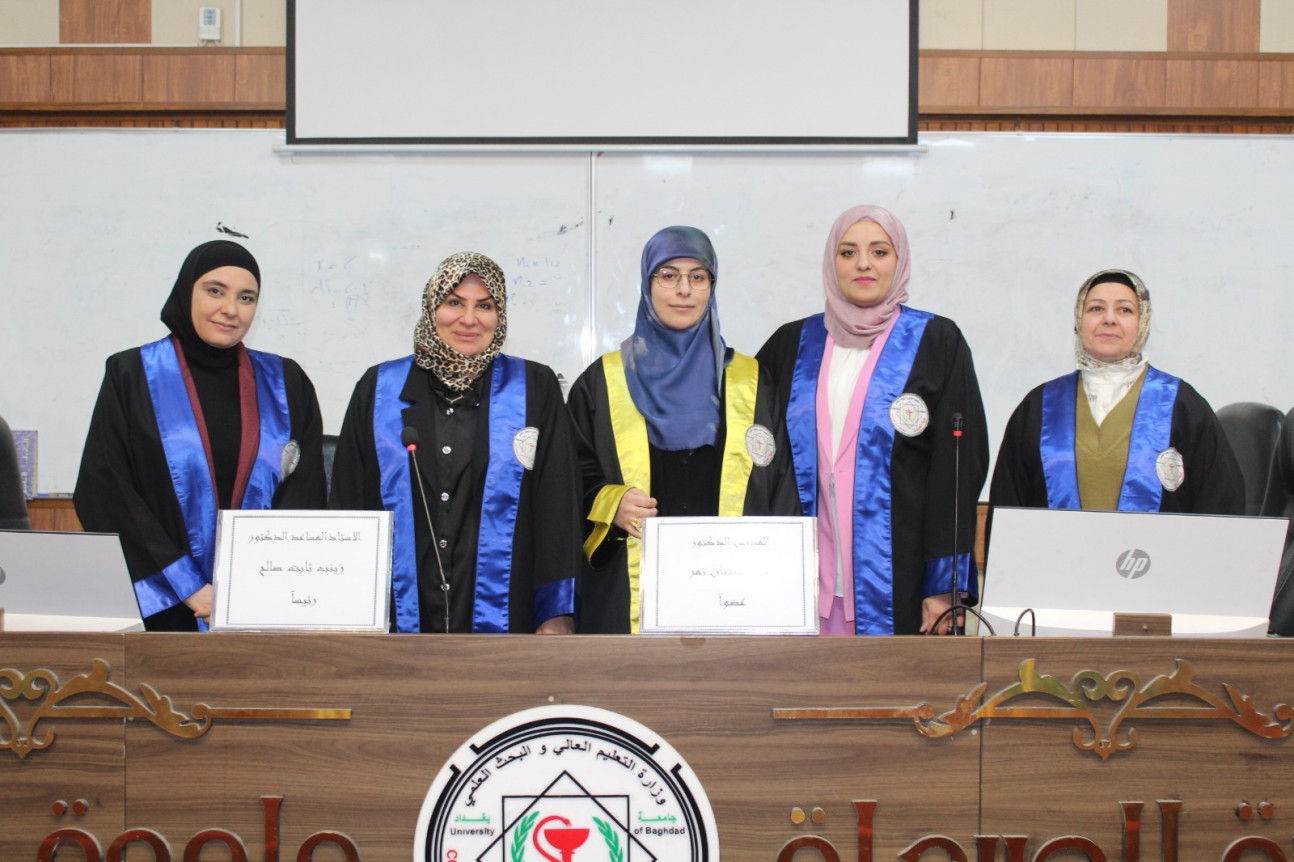

The College of Pharmacy discussed the master’s thesis titled “Preparation and Evaluation of Gel-Loaded Fluconazole Spanethosomes for Topical Delivery”, by the student Saja Taher Sahib and the supervisor, Assistant Professor Dr. Lubna Abdalkarim Sabri, at the Pharmaceutics Department.
The study aimed to develop an innovative topical drug delivery system for fluconazole to address challenges associated with its topical use, such as poor skin penetration and limited retention at the application site.
The study involved preparing twenty-one pharmaceutical formulations of fluconazole-loaded spanethosomes using the ethanol injection method. Two edge activators were used: Tween 80 and sodium deoxycholate, in addition to Span 60 as the vesicle bilayer builder. These formulations underwent several evaluation tests, including measurement of vesicle size, polydispersity index, drug entrapment efficiency, and in-vitro drug release studies. Additional analyses were conducted on the optimal formulations, including morphological examination of the vesicles, zeta potential measurement, and Fourier Transform Infrared (FTIR) spectroscopy. Two selected formulations were incorporated into a gel system using gel-forming agents carboxymethyl cellulose and xanthan gum at concentrations of 1% and 2% w/w. The prepared gels were then evaluated for their physical properties, including general appearance, pH values, drug content, and in-vitro fluconazole release rate.
The results showed that 2% xanthan gum gel was the most suitable for incorporating spanethosome vesicles, as it provided sustained release of fluconazole without causing any skin irritation. Also, biological tests demonstrated that the gel containing spanethosome vesicles produced a larger fungal growth inhibition zone compared with the conventional gel lacking these nanovesicles. Furthermore, stability studies showed that the prepared gel maintained its physical and chemical properties when stored at 4°C and 25°C for three months, indicating good stability of the developed drug delivery system.
The study recommended the possibility of adopting the fluconazole-loaded spanethosome system within topical antifungal preparations, as well as expanding the use of nanotechnology in developing more effective and stable topical drug delivery systems.