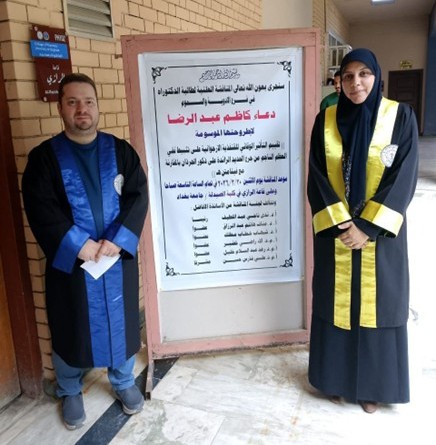
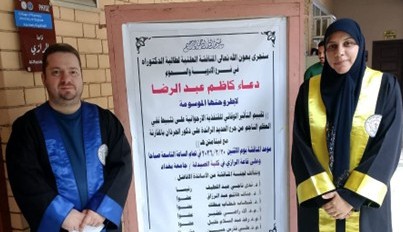
The College of Pharmacy discussed the PhD dissertation entitled “Evaluation of the Protective Effect of Echinacea purpurea on Iron Overload-Induced Multi-Organ Damage in Male Rats: In Comparison with Vitamin E” by the student Duaa Kadhim Abdul Ridha and the supervisor, Assistant Professor Dr. Ali Faris Hassan, at the Pharmacology and Toxicology Department.
The study aimed to evaluate the protective effect of Echinacea purpurea at two doses against bone marrow suppression and liver and spleen damage induced by iron overload, compared with vitamin E.
The study included fifty male rats divided into five groups of ten and treated as follows: group I rats received 1 mL of normal saline orally for four consecutive weeks and a single intraperitoneal (IP) injection of 0.2 mL saline every three days, group II rats received 1 mL of normal saline orally for four consecutive weeks and a single IP injection of iron dextran at 200 mg/kg every three days, group III rats received 100 mg/kg of Echinacea purpurea orally for four consecutive weeks and a single IP injection of iron dextran at 200 mg/kg every three days, group IV rats received 200 mg/kg of Echinacea purpurea orally for four consecutive weeks and a single IP injection of iron dextran at 200 mg/kg every three days, group V rats received 200 mg/kg of vitamin E oil solution orally for four consecutive weeks and a single IP injection of iron dextran at 200 mg/kg every three days. After 24 hours from the final administration, the rats were anesthetized, and samples of blood, liver, spleen, and bone marrow tissues were collected for histopathological, biochemical and gene expression analyses.
The results showed improvements in liver, spleen, and bone marrow tissues in rats pretreated with Echinacea purpurea, along with reductions in liver enzyme levels (LDH and AST) and in serum ferritin and hepcidin levels compared with the second group. Additionally, pretreatment with Echinacea purpurea reduced iron overload–induced oxidative stress by increasing GSH and SOD levels and decreasing MDA levels in liver tissues, and by increasing the gene expression of Nrf2 and sirtuin-3 in spleen tissues. Furthermore, pretreatment with Echinacea purpurea alleviated inflammation caused by iron overload by reducing serum levels of IL-6 and MCP-1, and decreasing the gene expression of TNF-α, IL-1β, and NF-κB in spleen tissues. Moreover, Echinacea purpurea pretreatment inhibited iron overload–induced apoptosis by reducing the gene expression of Akt-1 and FOXO-1 in spleen tissues.
The study recommended conducting further preclinical and clinical evaluations of Echinacea purpurea to confirm its safety and to establish its role as an adjuvant agent in protecting organs against toxicity induced by other iron salts, drugs, xenobiotics, and chemotherapeutic agents.