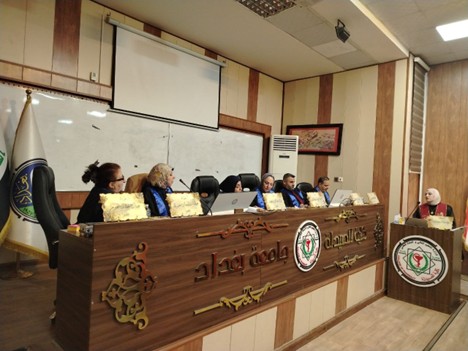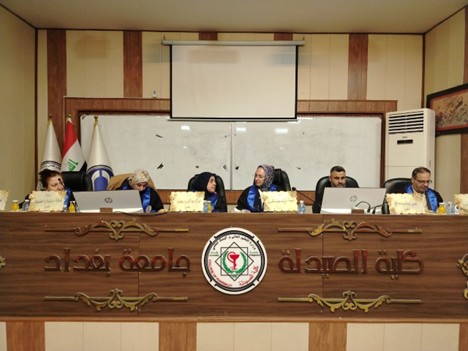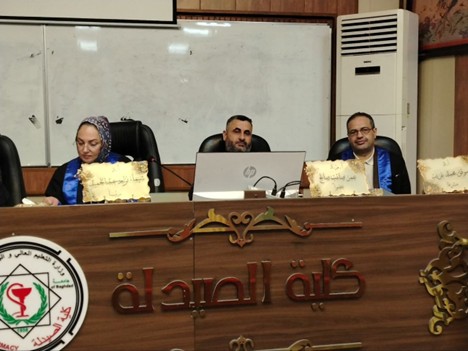

The College of Pharmacy discussed the PhD dissertation entitled “Albumin–Based Nanoparticles Loaded with Bortezomib: Preparation, Optimization, and In Vitro and In Vivo Evaluation” by the student Areej Wahab Abduljaleel and the supervisor, Professor Dr. Muwaffaq Mohammed Ghareeb, at the Pharmaceutics Department.
The study aimed to design and develop nanoparticles from bovine and human albumin to enhance targeting of cancer cells, thereby reducing the side effects associated with the administration of the anticancer drug bortezomib (BTZ).
The study included development of bortezomib-loaded albumin nanoparticles (BTZ-ANPs) using a Box–Behnken statistical design to evaluate critical variables. The nanoparticles were then characterized in terms of particle size, polydispersity index, and drug loading efficiency. Also, the effects of various factors were investigated, including drug amount, albumin concentration, antisolvent volume, albumin type, stirring speed, rate of antisolvent addition, type of crosslinking agent used for nanoparticle hardening, and the pH of the albumin solution. The in vivo study involved histopathological examination and tumor size measurement in three groups of BALB/c mice bearing 4T1 cells after administration of phosphate-buffered saline (PBS), BTZ and BTZ-ANPs to the first, second and third group respectively. Additionally, compatibility studies of the formulation components were performed using differential scanning calorimetry and Fourier transform infrared spectroscopy.
The results showed that the developed BTZ-ANPs using the Box–Behnken design yielded nanoparticles with an average size of 74 nm, an encapsulation efficiency of 68%, and a polydispersity index of 0.007. Furthermore, in vivo tumor size analysis showed greater tumor growth inhibition in the BTZ-ANPs group compared to the PBS and BTZ groups. In addition, histopathological findings revealed clear signs of therapeutic efficacy, including lower mitotic count and nuclear pleomorphism, increased apoptosis rate, and improved immune cell infiltration compared to the control and BTZ groups.
The study recommended conducting future studies using a larger animal scale and examining the stability of the developed BTZ-ANPs for a longer period, given the promising potential these particles have shown at enhancing the anti-cancer drug targeting without compromising the integrity of its chemical structure