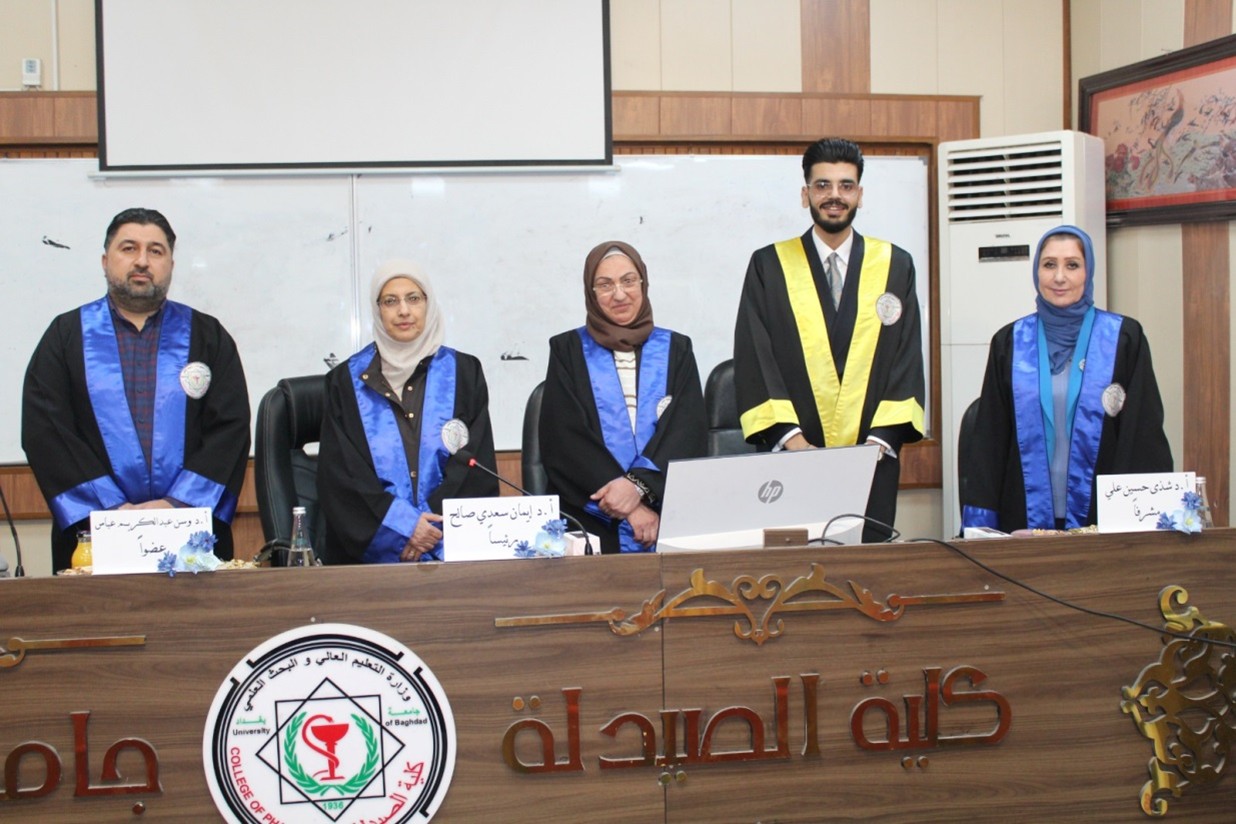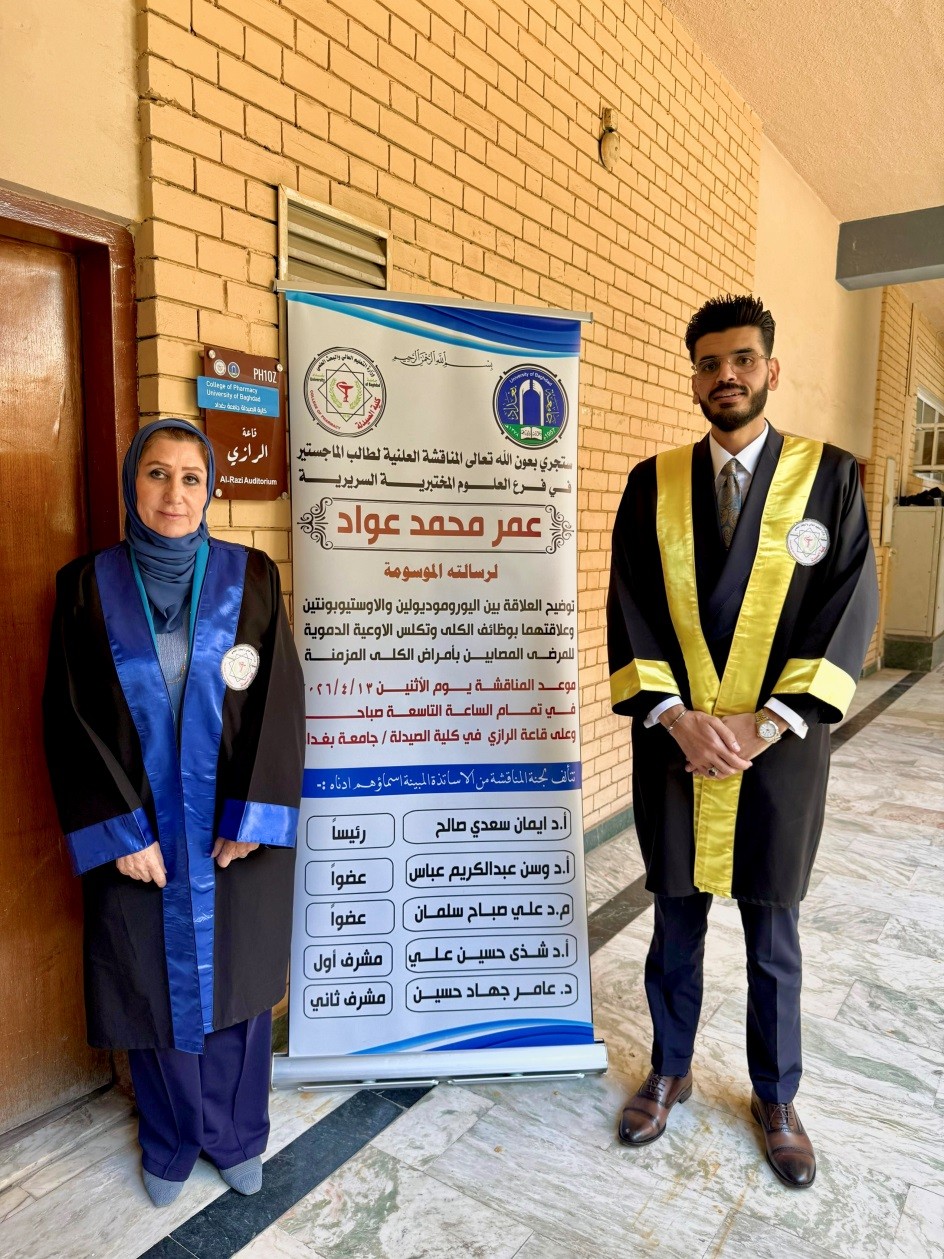

The College of Pharmacy discussed the MSc thesis entitled “Investigating the Correlation Between Uromodulin, Osteopontin in Relation to Kidney Function and Vascular Calcification in Patients with Chronic Kidney Disease” by the student Omar Mohammed Awad and the supervisor, Professor. Dr. Shatha Hussein Ali, at the Clinical Laboratory Sciences Department.
The study aimed to investigate the role of both osteopontin and uromodulin as biomarkers in chronic kidney disease (CKD), to examine their relationship with vascular calcification in Iraqi patients, to assess the presence and severity of vascular calcification using Doppler ultrasound of the femoral artery, and to correlate these findings with the levels of these biomarkers.
The study included 86 adults: 30 apparently healthy individuals and 56 patients with CKD (30 in stage III, 11 in stage IV, and 15 in stage V). Clinical data and routine biochemical measurements were collected, and serum levels of osteopontin and uromodulin were measured. Vascular calcification was evaluated using ultrasound imaging of the femoral artery, with documentation of the presence or absence of calcified plaques. Differences between groups and correlations between biomarkers and vascular calcification were analyzed using appropriate statistical tests.
The results showed a progressive decrease in uromodulin levels with advancing stages of CKD and an increase in osteopontin levels with deterioration of kidney function. Vascular calcification was not observed in healthy individuals or in stage III patients (0%) but was present in 18.2% of stage IV patients and 33.3% of stage V patients. The study concluded that the progression of CKD in this Iraqi cohort was associated with a significant decrease in serum uromodulin levels and a concurrent increase in osteopontin levels, along with the appearance of vascular calcification in advanced stages. This pattern—low uromodulin and high osteopontin—was strongly associated with the presence of vascular calcification, supporting their potential role as complementary biomarkers for assessing the risk of vascular calcification in patients with renal impairment.
The study recommended the routine measurement of osteopontin and uromodulin in the serum of CKD patients to aid in the early identification of individuals at higher risk of vascular calcification and disease progression. Also , it emphasized the importance of conducting larger, multicenter studies to enhance statistical power and the generalizability of findings to CKD populations in Iraq and the Middle East. Researchers are encouraged to use advanced imaging techniques, such as computed tomography, to improve the accuracy and sensitivity of detecting vascular calcification compared with ultrasound. There is a need for longitudinal follow-up studies to determine whether changes in osteopontin and uromodulin levels precede, predict, or result from the development of vascular calcification in patients with renal failure. Furthermore, more experimental research is needed to clarify the molecular mechanisms linking decreased uromodulin and increased osteopontin with vascular smooth muscle cell calcification and chronic inflammation. Finally, interventional studies are strongly recommended to evaluate whether improving mineral and bone disorders, controlling phosphate levels, reducing inflammation, or preserving renal tubular function can positively influence these biomarkers and slow the progression of vascular calcification.