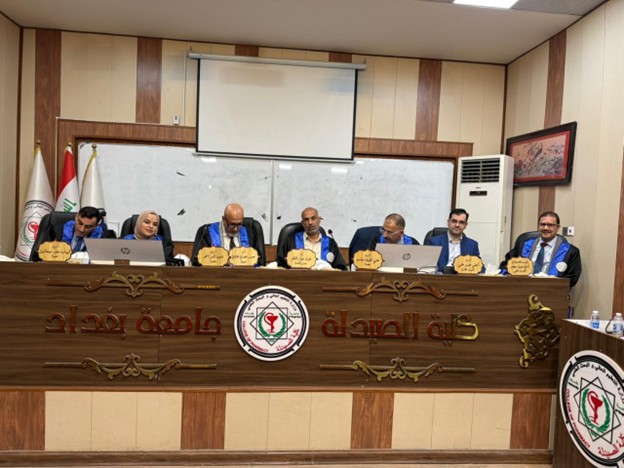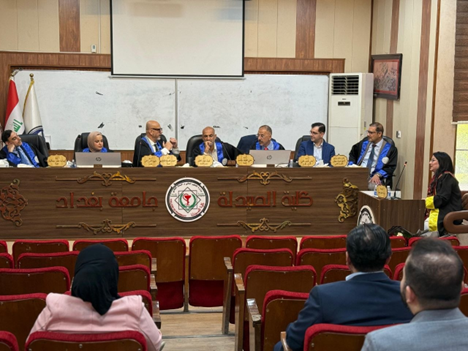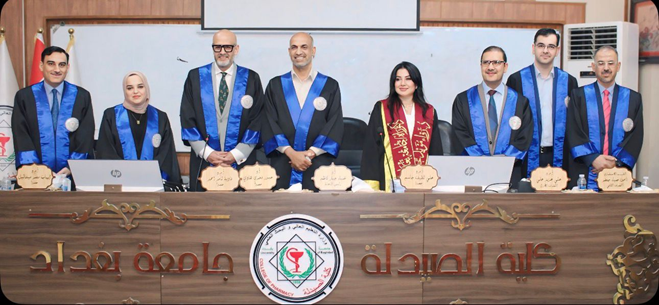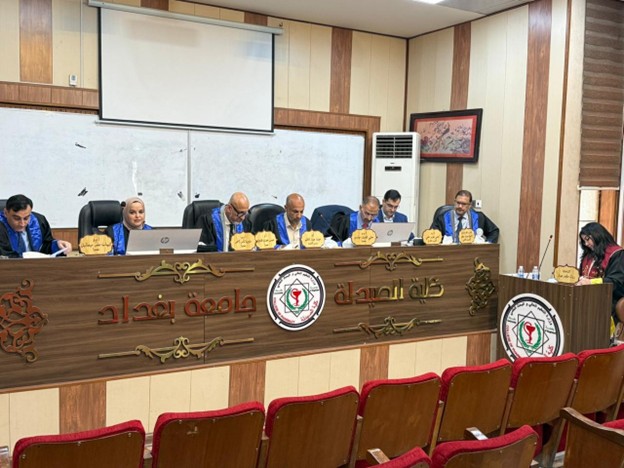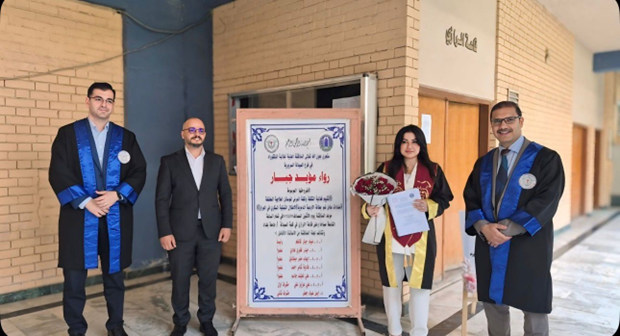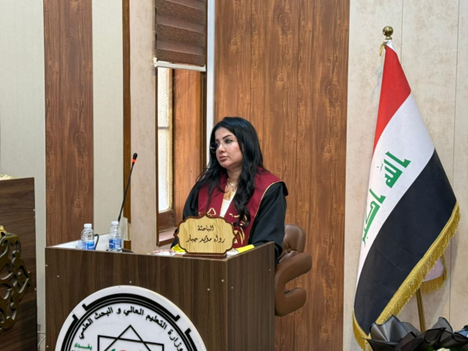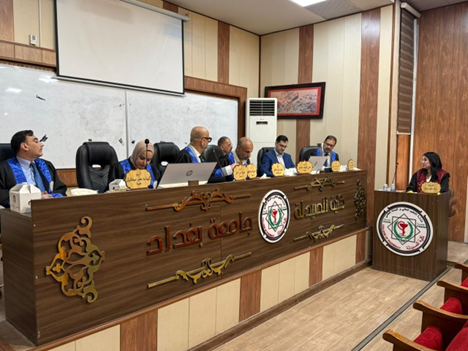
The College of Pharmacy discussed the PhD dissertation entitled “Assessing the Cost-effectiveness and the Cost of Illness of Different Therapeutic Modalities (Anti-VEGF) for Diabetic’s Retinopathy in Iraq”. By the student candidate Rawaa Moaiaad Jabbar, and the supervisor Assistant Professor Dr. Ali Azeez Al‑Jumaili , at the Clinical Pharmacy Department, with co‑supervision from Specialist Ophthalmologist Dr. Ayman Dhia, Ibn Al‑Haytham Eye Hospital.
The study aimed to comprehensively evaluate the burden of diabetic retinopathy by integrating three main dimensions: cost of illness (COI) analysis, assessment of the human burden on patients and caregivers, and cost-effectiveness analysis (CEA) of commonly used anti-VEGF therapies, namely Bevacizumab (Avastin®) and Aflibercept (Eylea®), under two treatment regimens: treat-and-extend (T&E) and pro re nata (PRN).
The study included three phases: cost of illness analysis for 994 eyes in 603 patients, human burden assessment, and cost-effectiveness analysis conducted over the period (October 2024 – October 2025). Cost analysis was performed using a bottom-up partial estimation approach from the perspectives of the Ministry of Health and patients, based on medical records and interviews, with statistical comparison using one-way ANOVA. The human burden was assessed in 200 patients using a vision-related quality of life questionnaire and in 581 caregivers using a caregiver burden scale. The economic evaluation compared Bevacizumab and Aflibercept across different dosing regimens, measuring effectiveness using best corrected visual acuity and calculating the incremental cost-utility ratio under two vial-sharing scenarios.
The results showed that the annual medical cost was approximately 678,000 USD, with anti-VEGF therapies being the main cost driver, while patient expenditures reached 270,000 USD, with a predominance of non-medical costs. Quality of life was moderately affected, and caregiver burden ranged from mild to moderate with notable social impact. Economically, Aflibercept was more effective but highly costly, whereas Bevacizumab under the treat-and-extend regimen was the most cost-effective option. Diabetic retinopathy represents a multidimensional burden encompassing visual, financial, psychological, and social aspects. Despite the clinical effectiveness of anti-VEGF agents, they constitute the major cost driver for both the healthcare system and patients. Although Aflibercept demonstrates superior clinical efficacy, Bevacizumab in a treat-and-extend regimen offers the best balance between cost and effectiveness, while Aflibercept remains an option for cases unresponsive to Bevacizumab.
The study recommends adopting biosimilar alternatives from reputable sources to reduce expenditure and ensure treatment sustainability, providing psychological and social support for caregivers and patients’ families, and preferring the treat-and-extend regimen over the pro re nata regimen due to its greater economic and clinical efficiency.