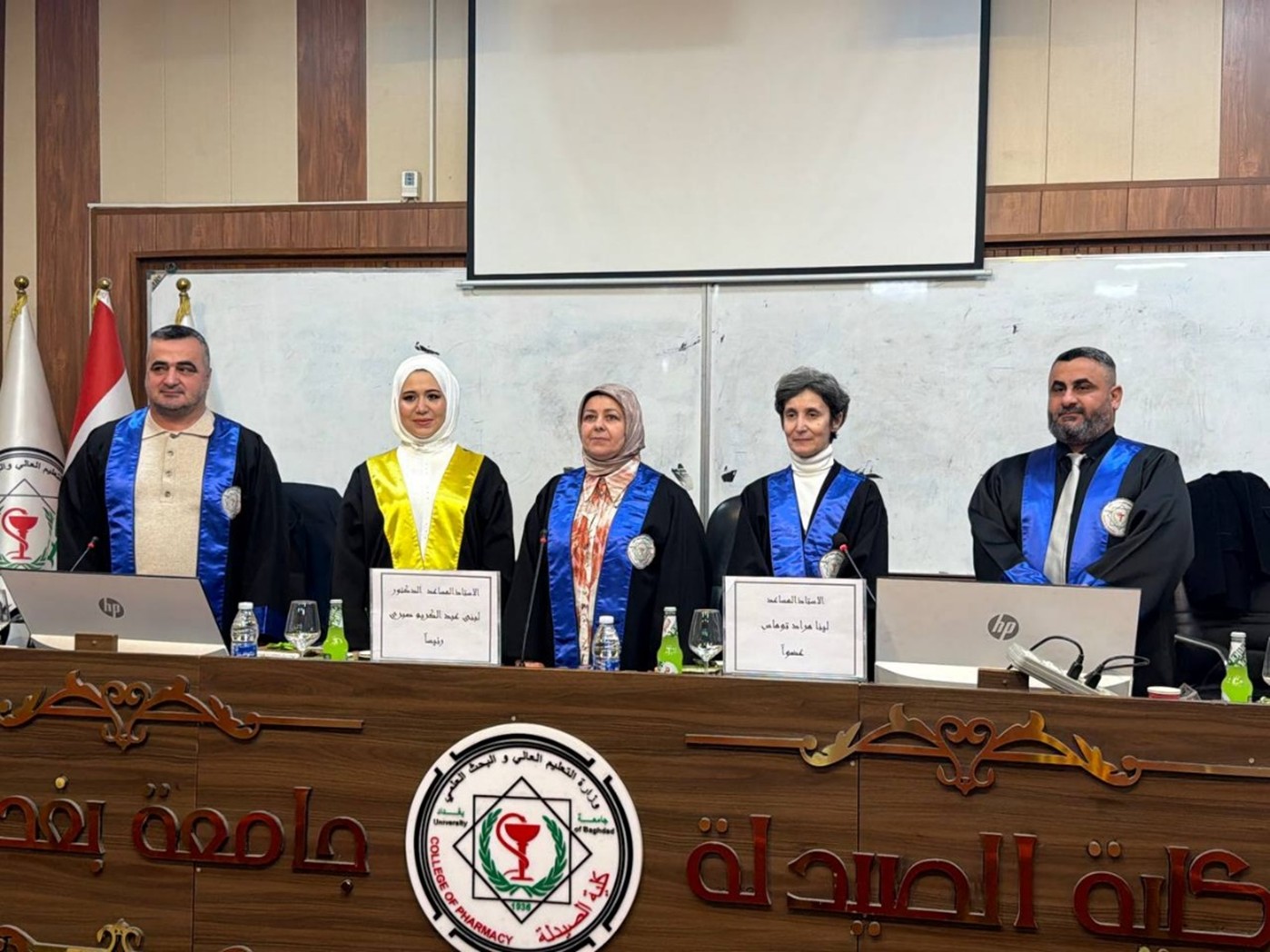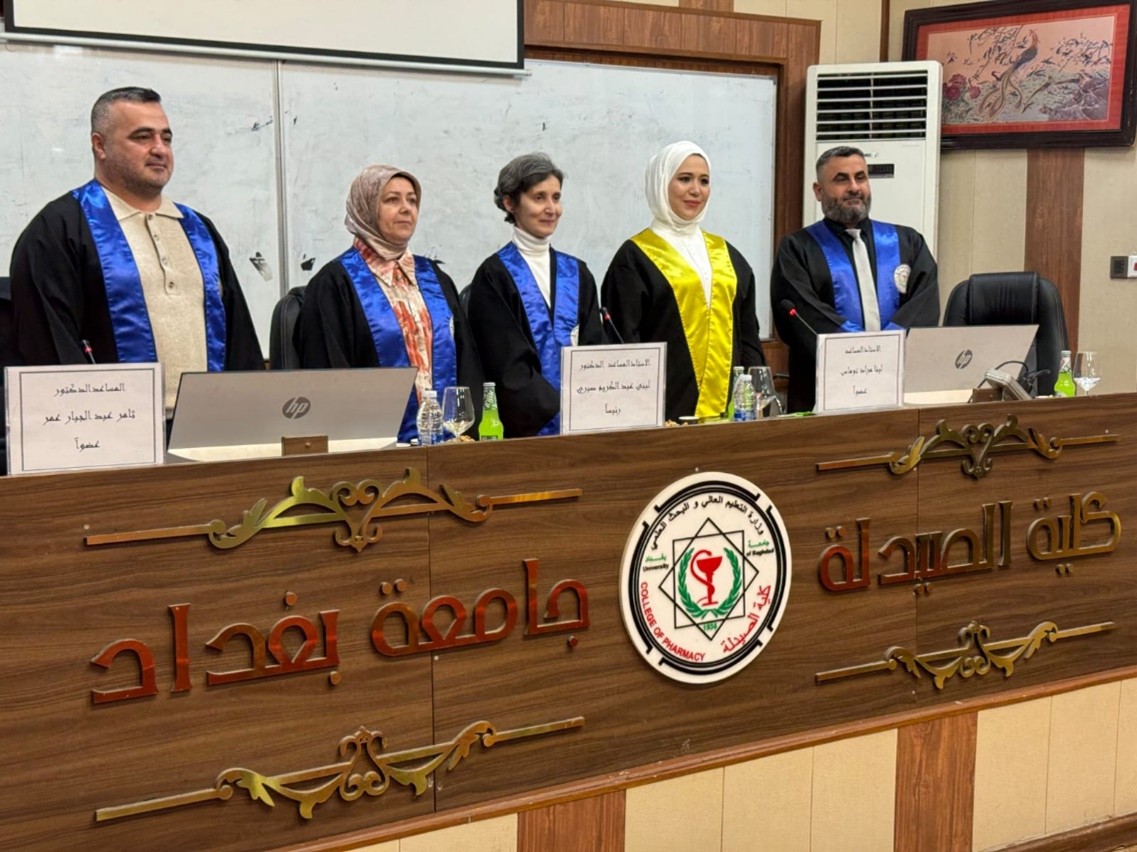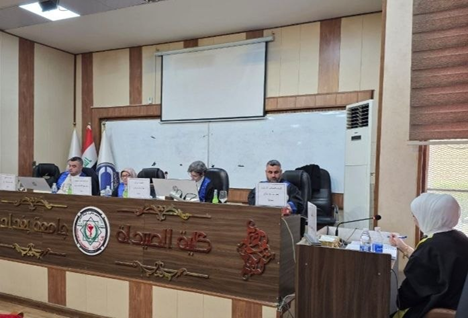

The College of Pharmacy discussed the MSc thesis entitled “Preparation and Characterization of Butenafine HCl Nanosuspension based in-situ Gel for Ophthalmic Delivery” by the student Nibras Mahdi Naeem and the supervisor, Assistant Professor Dr Omer Saeb Salih , at the pharmaceutics Department.
The study aimed to improve the solubility and efficacy of Butenafine Hydrochloride by preparing it as a nanosuspension and converting it into an in-situ gel for ocular application.
The study included the preparation of a nanosuspension of Butenafine Hydrochloride using the solvent/antisolvent technique with different polymers. The formulations were evaluated in terms of particle size, polydispersity index, drug content, and entrapment efficiency. Saturation solubility studies were also carried out using different stabilizers. The optimized formulation was characterized using Fourier Transform Infrared Spectroscopy, Differential Scanning Calorimetry, Powder X-ray Diffraction, and Field Emission Scanning Electron Microscopy. In vitro dissolution studies were conducted to evaluate the drug release behavior. Subsequently, the selected nanosuspension was incorporated into an in-situ gel using Poloxamer 407, Poloxamer 188, and hyaluronic acid. The gel formulations were evaluated for pH, clarity, gelation temperature, gelation time, osmolarity, and drug release.
The results showed that a significant improvement in solubility when Soluplus was used compared with other stabilizers. The optimized formulation (F13) showed a particle size of approximately 78 nm with a low polydispersity index, indicating homogeneous distribution. A high drug content of about 99% and an entrapment efficiency of approximately 96% were achieved. The formulation exhibited controlled drug release reaching about 95% within 120 minutes. Fourier Transform Infrared Spectroscopy confirmed the absence of chemical interaction, while Differential Scanning Calorimetry and Powder X-ray Diffraction indicated reduced crystallinity with a semi-amorphous behavior. Stability studies showed slight changes in particle size under different storage conditions. The in-situ gel demonstrated a suitable pH and an acceptable gelation temperature ranging from 29–34 °C, with complete drug release within 8 hours.
The study recommends further investigations on long-term stability, in vivo studies, and ocular safety evaluation, with the possibility of applying this delivery system to other poorly soluble drugs.