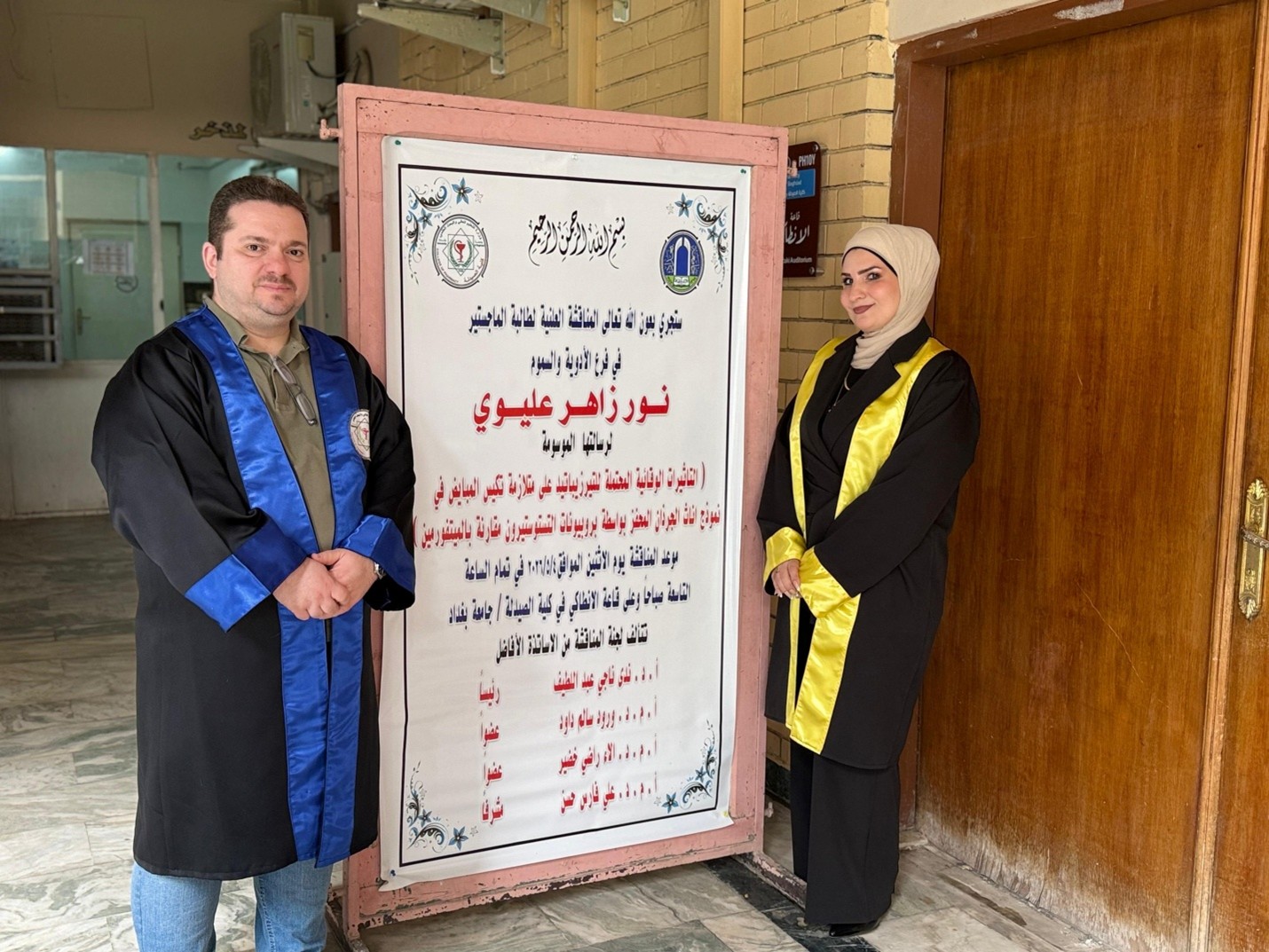
The College of Pharmacy discussed the MSc thesis entitled “Possible Ameliorative Effects of Different Doses Tirzepatide on Polycystic Ovary Syndrome in Female Rats Model Induced by Testosterone Propionate in Comparison to Metformin” by the student Noor Zahir Olewi and the supervisor, Assistant Professor Dr. Ali Faris Hassan, at the Pharmacology and Toxicology Department.
The study aimed to evaluate the effects of different doses of tirzepatide on hormonal parameters, metabolic profiles, inflammatory markers, and histopathological changes in a rat model of polycystic ovary syndrome induced by testosterone propionate in comparison with metformin.
The study included thirty healthy prepubertal female Wistar albino rats, each weighing between 80-100 g, which were maintained on a standard pellet diet with free access to tap water. The animals were randomly divided into five groups, with six rats in each group, as follows:
- Group I (Negative Control/Vehicle Control): Rats received a daily subcutaneous injection of 0.5 mL propylene glycol for 30 days (induction phase), followed by 0.5 mL of distilled water administered orally via gavage for 14 days (treatment phase).
- Group II (Induction/PCOS Model): Polycystic ovary syndrome was induced by administering 10 mg/kg/day of testosterone propionate subcutaneously for 30 days, followed by 0.5 mL of distilled water via oral gavage for 14 days.
- Group III (Tirzepatide 0.88 mg/kg): Rats received 10 mg/kg/day of tirzepatide subcutaneously for 30 days, followed by treatment with 0.88 mg/kg/week of tirzepatide subcutaneously for 14 days.
- Group IV: Rats were administered 10 mg/kg/day of tirzepatide subcutaneously for 30 days, then treated with 1.32 mg/kg/week of tirzepatide subcutaneously for 14 days.
- Group V: Rats received 10 mg/kg/day of tirzepatide subcutaneously for 30 days, followed by treatment with 300 mg/kg/day of metformin administered via oral gavage for 14 days.
On day 45, the animals were anesthetized with ether and euthanized by cervical dislocation. Blood samples were then collected for serum separation. The ovaries were excised, washed with phosphate-buffered saline (PBS, pH 7.4) at 4°C, and preserved for subsequent biochemical, molecular, and histopathological analyses.
The study concluded that tirzepatide produced a dose-dependent improvement in the features of polycystic ovary syndrome (PCOS). The 1.32 mg/kg dose effectively restored hormonal and metabolic parameters, including cholesterol, glucose, insulin levels, body weight, and ovarian weight. It also downregulated the expression of inflammatory cytokines (IL-6 and TNF-α) and exerted anti-apoptotic effects, with outcomes statistically comparable to those observed with metformin at 300 mg/kg. Furthermore, tirzepatide significantly reduced the relative mRNA expression of TNF-α and IL-6 and suppressed caspase-3 protein expression in ovarian tissue. This modulation attenuated inflammatory and apoptotic pathways involved in follicular atresia. In addition, the treatment restored ovulatory function and re-established normal ovarian histoarchitecture, as evidenced by the reappearance of corpora lutea and a marked reduction in cystic follicle formation.
The study recommended the evaluation of long-term fertility outcomes, such as pregnancy rates and embryo quality, which necessitates further research to confirm the reproductive safety of dual incretin agonists. It also highlighted the importance of investigating the role of the gut microbiota in polycystic ovary syndrome and the potential effects of tirzepatide on intestinal bacterial composition. Moreover, it recommended assessing AMH levels to improve the accuracy of ovarian reserve estimation and follicular dynamics. Additionally, monitoring the estrous cycle throughout the experimental period and standardizing the timing of animal sacrifice were suggested to reduce biological variability and enhance the reliability of hormonal and histological interpretations.