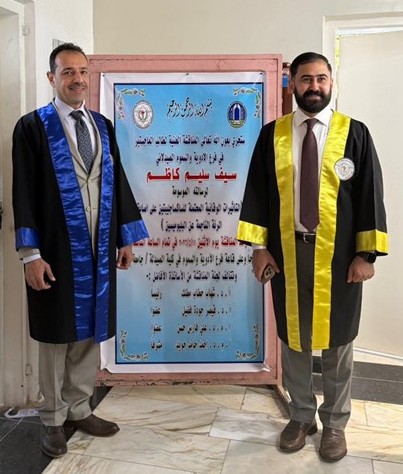

The College of Pharmacy discussed the MSc thesis entitled “Possible Protective Effects of Saxagliptin on Bleomycin-Induced Pulmonary Injury” by the student Saif Salim Kadhim and the supervisor, Assistant Professor Dr. Ahmed Hamed Jawad, at the Pharmacology and Toxicology Department.
The study aimed to evaluate the effects of different doses of saxagliptin on inflammatory, apoptotic, and fibrotic markers in lung tissues, in addition to histopathological changes, in a rat model of bleomycin-induced pulmonary fibrosis.
The study included 24 male albino rats, weighing between 180 and 220 g. The animals were maintained on a standard diet with free access to water throughout the experimental period. The study duration was 35 days, during which the animals were randomly divided into four equal groups, with six rats in each group. Group I (Control group): The animals received an organic solvent (DMSO 2%) orally once daily for 28 days. Group II (Bleomycin Group): Pulmonary fibrosis was induced by a single intratracheal administration of bleomycin at a dose of 2.5 IU/kg for 28 days. Group III (Saxagliptin 5 mg/kg + Bleomycin): Animals received saxagliptin at a dose of 5 mg/kg/day dissolved in 2% DMSO orally by gastric gavage once daily for 35 days, along with a single intratracheal dose of bleomycin (2.5 IU/kg) for 28 days. Group IV (Saxagliptin 10 mg/kg + Bleomycin): Animals received saxagliptin at a dose of 10 mg/kg/day dissolved in 2% DMSO orally by gastric gavage once daily for 35 days, along with a single intratracheal dose of bleomycin (2.5 IU/kg) for 28 days. In Groups III and IV, saxagliptin was administered seven days before the first dose of bleomycin and continued for 28 days after the start of bleomycin administration. On day 36, the animals were anesthetized with ether and then euthanized by cervical displacement. The lungs were then excised and washed with PBS at pH 7.4 and 4°C and preserved for biochemical, molecular, and histological analyses of lung tissue.
The results showed that bleomycin induced severe lung injury associated with marked inflammation, prominent apoptosis, and progressive fibrotic remodeling. Saxagliptin provided dose-dependent protection against these pathological alterations. Treatment with saxagliptin significantly reduced the levels of pro-inflammatory cytokines, including TNF-α and IL-6; suppressed apoptosis as evidenced by decreased caspase-3 expression, and attenuated fibrotic signaling with a marked reduction in Smad3 expression; although total TGF-β levels remained elevated. These findings were further confirmed by histopathological examination, which revealed reduced collagen deposition and partial to near-complete restoration of normal lung architecture at the higher saxagliptin dose. Overall, saxagliptin ameliorated bleomycin-induced lung injury through significant modulation of inflammatory, apoptotic, and fibrotic pathways, suggesting its potential therapeutic role in pulmonary fibrosis.
The study recommended conducting further investigations to evaluate the antioxidant effects of saxagliptin at different doses in lung tissues in order to achieve a more comprehensive understanding of its protective role. It also suggested exploring the potential synergistic effects between saxagliptin and other lung-protective agents to enhance its efficacy in reducing inflammation, apoptosis, and pulmonary fibrosis. Furthermore, future studies should focus on clarifying the molecular mechanisms underlying Smad3 inhibition and determining whether this effect results from reduced Smad3 phosphorylation, suppression of TGF-β receptor signaling, or regulation of Smad3 gene transcription. Additional research is also needed to determine whether saxagliptin reduces apoptosis through inhibition of the intrinsic mitochondrial pathway, the extrinsic death receptor pathway, or both pathways simultaneously. Finally, the study emphasized the importance of future clinical studies to confirm the potential therapeutic benefits of saxagliptin in the treatment of pulmonary fibrosis in humans.