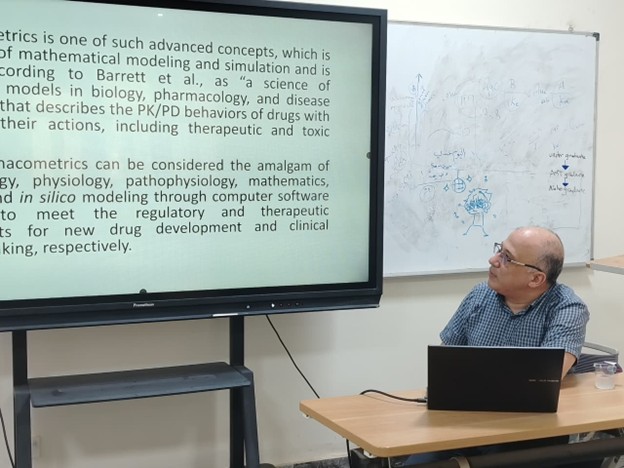

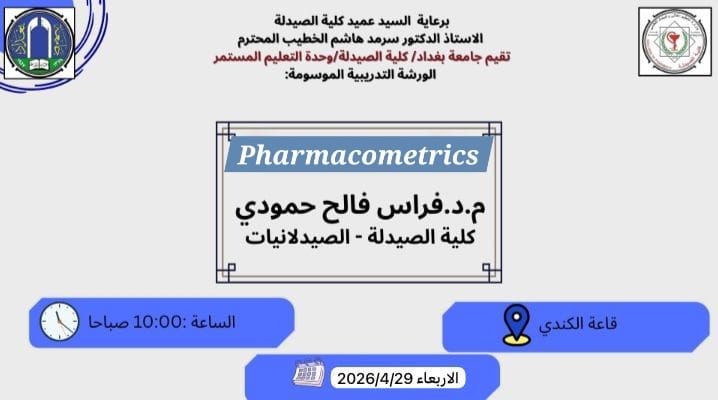
Under the supervision of the Dean of the College of Pharmacy, Professor Dr. Sarmed H. Kathem Alkhateeb, the Continuing Education Unit at the University of Baghdad/College of Pharmacy held an in-person workshop entitled “Pharmacometrics”, delivered by Lecturer Dr. Firas Falih Hamudi, a faculty member at the Pharmaceutics Department.
The workshop aimed to discuss the concept of pharmacometrics, its applications in the medical and pharmaceutical fields, and its role in improving drug therapy effectiveness and supporting clinical and regulatory decisions.
The workshop included several topics, including an introduction to pharmacometrics as a scientific discipline that relies on mathematical and statistical models to determine the relationship between drugs, diseases, and patient populations. It also highlighted the integration of pharmacokinetics and pharmacodynamics to predict drug behavior in the body, thereby contributing to dose optimization and clinical trial design. In addition, the workshop addressed the fundamental components of this field, including pharmacokinetics, which studies what the body does to a drug in terms of absorption, distribution, metabolism, and excretion. The practical applications of pharmacometrics in drug development were also discussed, particularly its role in helping pharmaceutical companies determine optimal dosing regimens, reduce the risk of clinical trial failure, and facilitate submission procedures to regulatory authorities. Furthermore, the workshop highlighted the importance of personalized medicine in enhancing therapeutic efficacy and drug safety for specific patient groups through individualized dosing regimens tailored to each patient’s condition. The workshop also reviewed population modeling as one of the main methodologies used in this field to identify and explain variability in drug responses among patients.
The workshop concluded that it is important to understand the interactions among the drug, the patient, and the disease through analyzing pharmacological and disease-related data, as well as measuring variability in individual drug responses according to different factors, thereby contributing to selecting optimal doses, achieving the best therapeutic outcomes, and minimizing adverse effects.