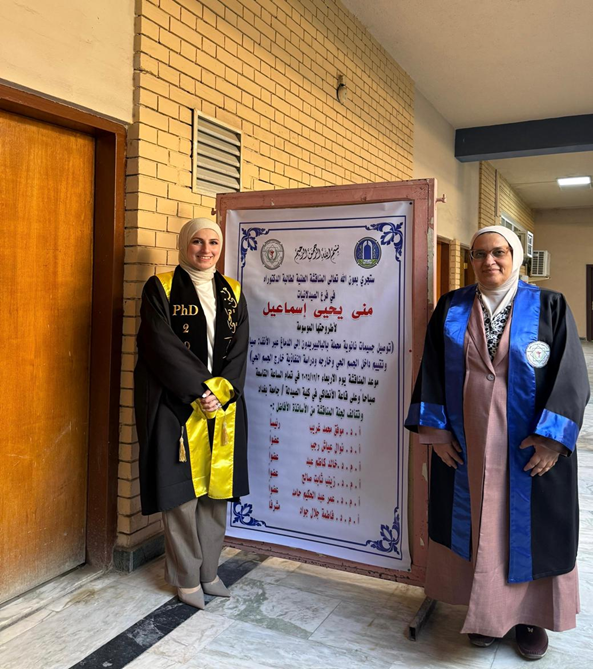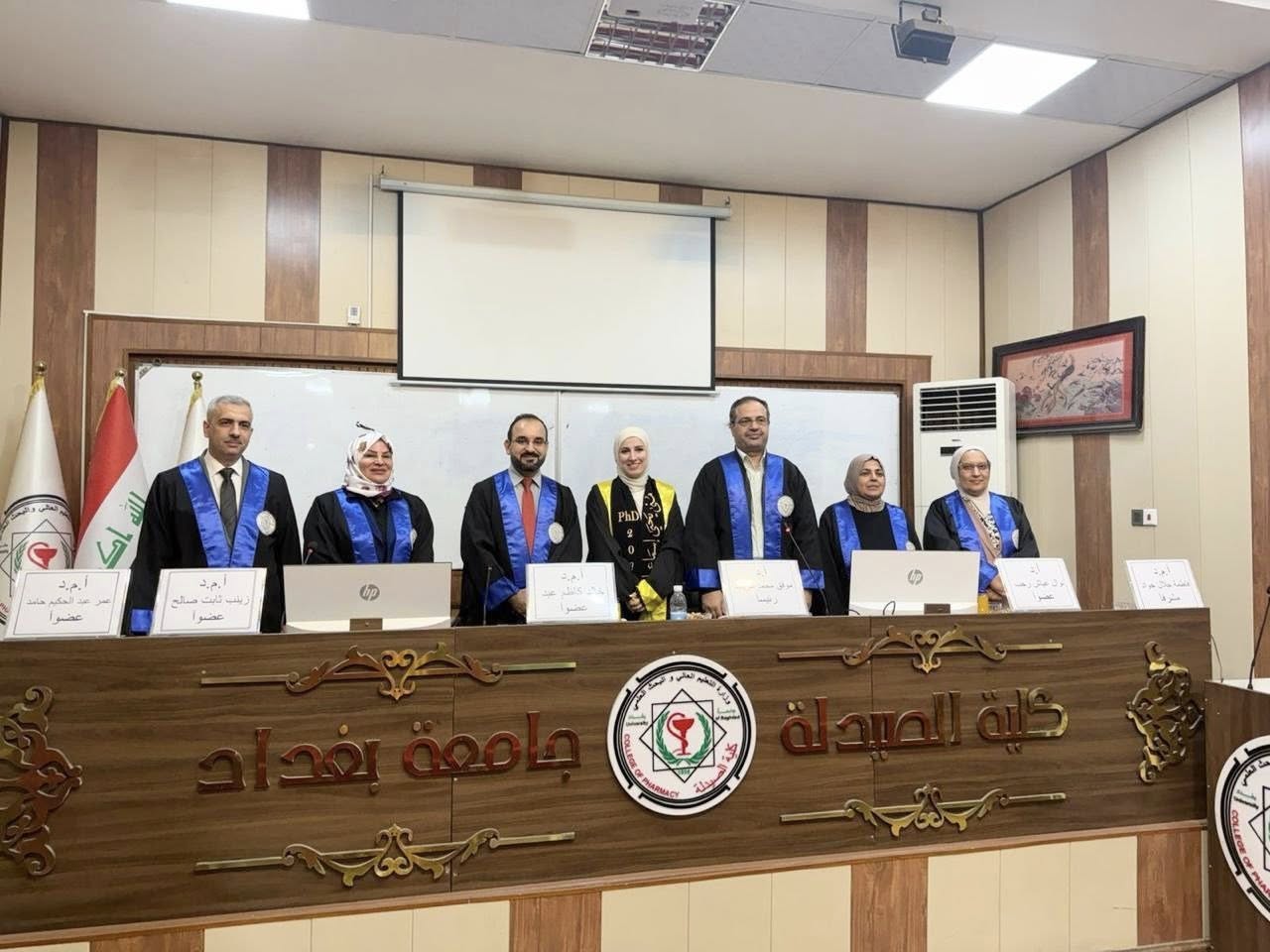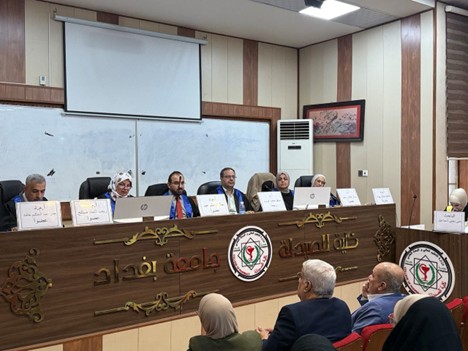
The College of Pharmacy discussed the PhD dissertation entitled “Paliperidone Loaded Nanoparticle in Situ Gel as Nose to Brain Delivery System: Preparation and In-Vitro/In-Vivo Evaluation”, by the student Muna Yehia Ismail and the supervisor, Assistant Professor Dr. Fatima Jalal, at the Pharmaceutics Department.
The study aimed to develop a novel nanoparticle drug-delivery system capable of transporting Paliperidone directly from the nasal cavity to the brain through the olfactory and trigeminal pathways, thereby bypassing the blood–brain barrier and improving the bioavailability of this poorly water-soluble antipsychotic drug.
The study included the preparation of 29 nanoparticle formulations using different stabilizers and preparation techniques, followed by evaluation of particle size, polydispersity index (PDI), zeta potential, drug-loading efficiency, and in vitro drug release. Subsequently, the optimized formula was incorporated into a mucoadhesive thermoresponsive in-situ gel for nasal application, after which ex vivo permeation studies and in vivo pharmacokinetic evaluation in rats were conducted.
The results showed that the optimized formula had the most efficient nanocarrier properties, with a small particle size, low PDI, and high drug-loading efficiency, and after being incorporated into the nasal gel, the formulation that consisted of 20% Poloxamer 407 and 1% HPMC K4 exhibited optimal gelation temperature, spreadability, and mucoadhesion. Furthermore, ex vivo permeation studies showed that the latter formulation enhanced Paliperidone permeation by 6-fold, and in vivo pharmacokinetic studies showed a 3-fold increase in brain drug concentration compared to intravenous administration.
The study recommended adopting the system mentioned above as a promising platform for effective nose-to-brain delivery of Paliperidone, and encouraged further animal and clinical studies to be conducted in the future to verify its effectiveness and safety in treating mental disorders.